
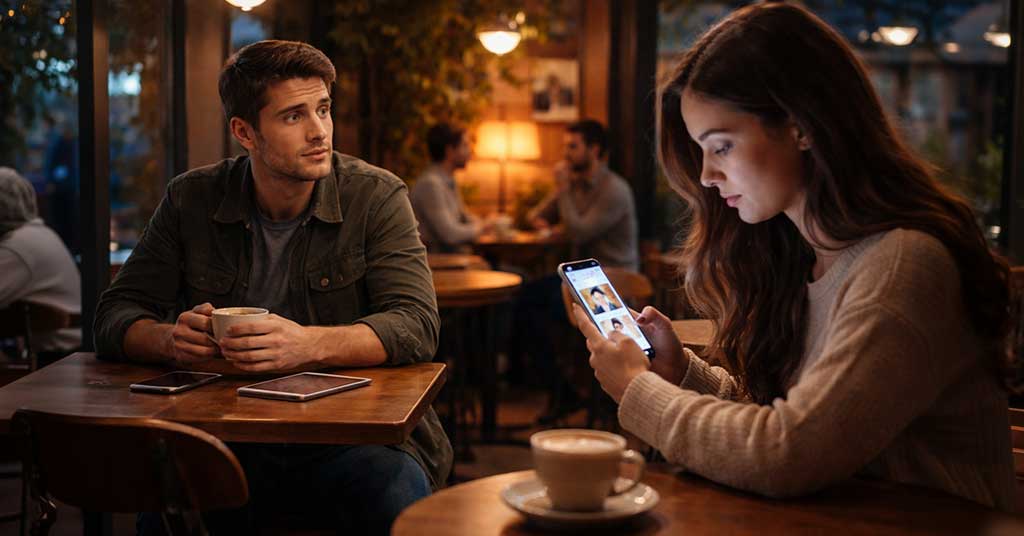
Dating didn’t get harder. It just got riskier
Online dating and social media have changed how many people, especially those under 35, view love. Instant messaging and constant availability have replaced the slow build of traditional courtship. Social media encourages quick judgments, reducing complex individuals to profiles and statistics.
Finding romance once required leaving your house, looking your best, having social skills, flirting, and showing genuine interest in someone. Today, with large swaths of the population sequestering themselves behind their screens, everything on the digital battlefield of love now revolves around comparison—of profiles, looks, status and lifestyle—which is cynical, fast and empty.
In that environment, no interaction ever feels settled. Every conversation competes with countless unseen alternatives, and every connection is weighed against what might be one swipe away. Comparison encourages hesitation rather than commitment, second-guessing rather than curiosity. Instead of focusing on the person in front of them, people are nudged to keep scanning, ranking and reassessing.
The result is a dating culture that rewards optionality over effort and detachment over investment. When everything feels provisional, patience makes less sense, and risk feels harder to justify. Romance, which once depended on sustained attention and trust, becomes another low-stakes transaction: easy to start, easier to abandon, and rarely allowed to deepen.
Young men are not only struggling to date; they are even afraid to try. Approaching a woman was once a rite of passage. Now many men see it as a risk because, while they are still expected to initiate romantic interaction, the social, professional and reputational consequences fall disproportionately on them if the woman judges the interaction to be unwanted.
The risk of “approaching” now extends well beyond rejection. It includes fears of public shaming online, job loss and reputational damage.
Romance has shifted toward instant gratification, exemplified by swiping left on Tinder to pass—judging someone solely on their looks and ignoring their character, skills, or values. Building authentic connections, let alone developing romantic relationships, has become much harder to sustain amid constant digital distraction and exposure to alternatives.
Just days after the World Health Organization (WHO) declared COVID-19 a global pandemic on March 11, 2020, Tinder recorded a record 3.2 billion swipes in a single day on March 29, 2020. Similar increases were observed across other dating platforms. The surge reflected individuals’ continued pursuit of connection during lockdowns, and even after the pandemic, activity on dating apps has remained high, driven in part by the perception that swiping and messaging are far less demanding than in-person interaction.
During COVID lockdowns, social media became an essential communication tool, and many people never fully returned to the social habits and skills dating once required. Data shows that 59 per cent of men aged 18 to 25 didn’t approach a woman in the past year. This isn’t merely social awkwardness from hiding behind screens; it’s learned fear, reinforced by social media.
Men are bombarded with mixed messages, such as:
Saying “Hello” makes you seem creepy.
Compliments are considered microaggressions.
If she’s not interested, you’ll be seen as a threat.
As a result, many men have stopped engaging not because they lack a desire for connection, but because they fear the consequences. That withdrawal has contributed to rising loneliness among men.
Social media and online dating haven’t only created a dating crisis; they have contributed to a broader social breakdown that demands a return to basics:
Normalizing real-world interaction instead of defaulting to email, text and direct messaging.
Teaching men and women to communicate effectively and respectfully.
Stopping the treatment of basic human curiosity as if it were a crime.
What cannot be ignored is that men and women are experiencing dysphoric singlehood—the feeling of being unwanted, disconnected and judged by appearance. The damage caused by social media and online dating affects both genders. If this digital path continues, romance won’t just decline; generations may never learn how to begin pursuing love at all.
Nick Kossovan is a self-described connoisseur of human psychology.
Explore more on Relationships, Social Media, Culture
The views, opinions, and positions expressed by our columnists and contributors are solely their own and do not necessarily reflect those of our publication.
Troy Media empowers Canadian community news outlets by providing independent, insightful analysis and commentary. Our mission is to support local media in helping Canadians stay informed and engaged by delivering reliable content that strengthens community connections and deepens understanding across the country.

