
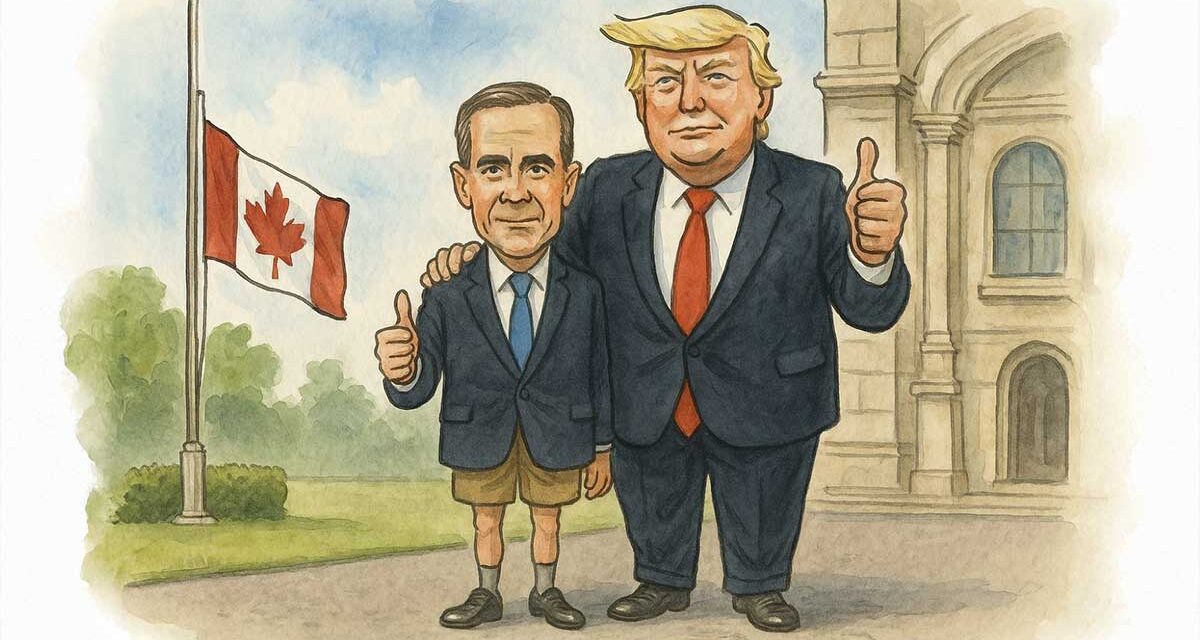
We are quick to point fingers at Trump, but Carney’s lack of a clear, consistent strategy is mostly at fault
There is something almost too convenient in how quickly Canadians point south when discussing unpredictability in trade. Yes, Donald Trump has long been synonymous with volatility. But focusing solely on Washington risks missing a more uncomfortable truth: Ottawa has become just as difficult to read.
Under Prime Minister Mark Carney, Canada’s posture toward the United States has shifted with surprising speed, less theatrical than Trump’s but no less consequential. In April 2025, he promised a renewed economic and security partnership. By the summer, the existing deal was described as the best possible outcome. Fast forward to April 2026, and suddenly, reliance on the U.S. is framed as a strategic weakness. All of this, notably, after months without meaningful engagement or negotiation.
This shift in messaging matters, especially when delivered in a widely viewed address suggesting that CUSMA (the Canada–United States–Mexico Agreement, which replaced NAFTA in 2020) is somehow on life support. It leaves industry asking a basic question: what exactly is the plan?
That lack of clarity extends beyond messaging into how Canada is organizing its response. The revival of a Trudeau-era advisory council on Canada-U.S. relations might suggest renewed seriousness. And to be fair, its composition is more balanced than critics might assume. Figures like Ken Seitz and Michael Harvey bring genuine expertise in fertilizers and agricultural trade, critical inputs for food production. Others offer adjacent perspectives: Jean Simard understands packaging and processing supply chains; Jonathan Price connects to resource extraction essential for fertilizer inputs; and P. J. Akeeagok brings a grounded view of food security in remote regions.
More important is what is missing: primary producers. Farmers. Western Canadian voices. Those operating at the very front lines of production. In a sector that is geographically vast and structurally complex, that omission is not trivial; it is strategic.
And it reinforces the larger problem. Canada is not speaking with clarity because it is not grounded in the realities of its own production base.
For an agri-food sector that, according to federal trade data, sends roughly 75 per cent of its exports to the United States policy ambiguity is not an academic concern, it is a business risk. Companies are not waiting for clarity. They are hiring consultants, restructuring supply chains, and preparing for a post-CUSMA environment. Not because it is inevitable, but because it is conceivable.
That alone should raise alarms.
The consequences of that uncertainty become clearer when compared to how others are acting. While Canada debates its posture, Mexico is moving decisively. Under Mexico’s president, Claudia Sheinbaum, the government has demonstrated a level of strategic discipline that Canada would do well to study. Despite repeated provocations, from being labelled a “narco-president,” to symbolic disputes like the renaming of the Gulf of Mexico, to the ever-present rhetoric around border walls, Mexico has largely refused to take the bait.
Instead of reacting to political distractions, it has stayed focused on trade, production and integration.
That approach has paid off. Mexico did not escalate or grandstand. It did not reframe the partnership as a liability. It simply continued to deepen its role within the North American economy. And in doing so, it has strengthened its position as the United States’ most reliable agricultural and manufacturing partner.
The result? Mexico is no longer just a participant in continental trade; it is becoming central to it. It is positioning itself as America’s fresh food basket, a year-round agricultural partner, and a seamless extension of the U.S. logistics and supply chain system.
Canada, by contrast, risks drifting into a narrower role: a bulk commodity supplier with diminishing influence over consumer-facing markets.
The contrast is striking. The U.S.-Mexico relationship is not without friction, but it is fundamentally aligned. Disputes happen within the partnership, not about its existence. Supply chains are being integrated, not questioned. The direction of travel is clear. Canada’s is not. And that is the real problem.
Trade relationships do not unravel overnight. They erode gradually—through hesitation, mixed messaging and missed opportunities. What we are witnessing today is not a collapse, but a gradual separation in strategic direction.
For a country whose prosperity is so tightly linked to cross-border trade, particularly in food, that is a risk we can ill afford.
Because in the end, markets reward certainty. And right now, Canada is offering anything but.
Dr. Sylvain Charlebois is senior director of the Agri-Food Analytics Lab at Dalhousie University and co-host of The Food Professor Podcast.
Explore more on Trade, Canada-U.S relations, Agri-food, USMCA
The views, opinions, and positions expressed by our columnists and contributors are solely their own and do not necessarily reflect those of our publication.
Troy Media empowers Canadian community news outlets by providing independent, insightful analysis and commentary. Our mission is to support local media in helping Canadians stay informed and engaged by delivering reliable content that strengthens community connections and deepens understanding across the country.

