
Dismissing them as old fashioned says more about us than about them

How did you spend your Family Day weekend? I enjoyed quality time with my wife and son, and was able to get in some pleasure reading, watching the Olympics and catching up on odds and sods.
I’m going to highlight two of the things I did. While they’re quite different in nature, they share one similarity that I’ll point out at the end. Let’s examine some tales of history-and the tail of an anthropomorphic mouse.
The former refers to the brilliant TV documentary series Civilisation: A Personal View by Kenneth Clark. Produced by the BBC, the 13 episodes aired from February to May 1969. It became the most-watched program on art history around the world. The accompanying volume to this series has never been out of print, either.
Civilisation’s host was Sir Kenneth Clark. One of Britain’s foremost art historians, he had served as a museum director to Oxford’s Ashmolean Museum in 1930 at age 27, followed by London’s National Gallery three years later. He wrote numerous books, taught fine art at the University of Oxford and, starting with his experimental 1958 Associated Television series, Is Art Necessary?, became a recognized figure on art history.
His documentary series examined the growth of western European civilization at the end of the Dark Ages to early 20th century art and architecture. Each 50-minute episode, including “The Skin of Our Teeth,” “The Hero as Artist,” “Grandeur and Obedience” and “The Worship of Nature,” provided an engaging look at art’s important role in western society. The influence of history, politics, music, religion, science, philosophy and literature became critical chapters in this illuminating discussion, too.
Civilisation was the pinnacle of Clark’s success.
The British Film Institute declared it a “pioneer achievement in its time” that helped “change the shape of cultural television.” The Guardian’s Jonathan Jones, to his credit, put aside the tired, fatuous modern criticisms of the series being “old fashioned” and “staid” in a Jan. 24, 2011 column. He praised the “exquisitely intelligent documentary” and Clark’s “intelligence and wisdom,” and suggested “you cannot get a clearer and more essentially truthful account of European art from AD 1000 to the 1800s in any textbook than you will find here.”
Morgan Meis made this scintillating analysis in The New Yorker on Dec. 21, 2016, “‘Clark’s great virtue is his restraint: he sets the stage; he heightens the mood; then he—or rather, one of the show’s three directors—lets the camera have a leisurely look at whatever he’s been talking about. This is the use of television as a contemplative tool, something rarely attempted and, when done well, still remarkable.”
I couldn’t agree more. I’ve watched Civilisation several times over the years. The entire series can be accessed at the BBC website, or you can look up individual episodes on YouTube. It remains as fresh, intriguing and intellectually stimulating as ever. While Civilisation shouldn’t replace great books on the history of art, it should hopefully inspire viewers to learn more about every subject that Clark covered with expertise.
Let’s move on to the tail of an anthropomorphic mouse: Topo Gigio.
The fictional mouse was created in 1958 by three talented Italians: artist Maria Perego, her husband Federico Caldura, and fellow artist Guido Stagnaro. It was originally a puppet that first appeared on the RAI program Serata di gala in 1959, followed by appearances on lta fedeltà, Canzonissima and Zecchino d’Oro. The mouse became the main character on Storie di Topo Gigio, a massively popular children’s TV show on RAI during the 1960s. Some movies were made, including The Magic World of Topo Gigio (1961) and Topo Gigio and the Missile War (1967), and two animated series (Topo Gigio in Japan, 1988-1990 and Topo Gigio in Italy, 2019-2020).
Topo Gigio remains a popular character in Italy. There’s an active website with a dedicated page to Perego, who passed away in 2019, along with photos of the mouse with Sullivan, Louis Armstrong, Ray Astor, and Michael Jackson, cartoons, an online store and more. Topo Gigio was even Italy’s spokesperson (or “spokesmouse,” I suppose!) during the final of the Eurovision Song Contest 2025.
The little mouse went on to become a household name around the world, too. How did this come to pass? An American TV host who had a really big shoo … err, show!
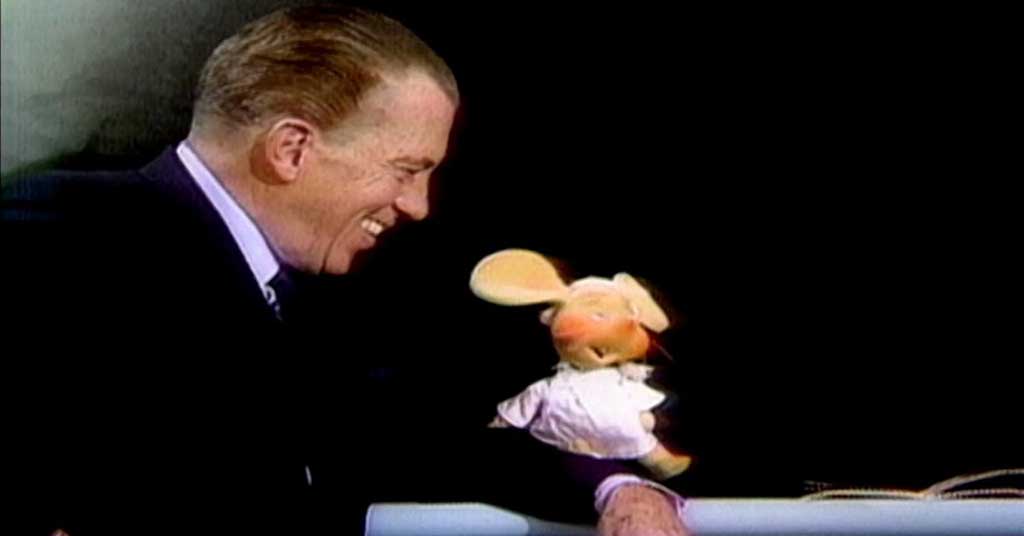
That’s right. Topo Gigio had a recurring segment on The Ed Sullivan Show between 1962 and 1971. Four puppeteers controlled the 10-inch-tall (or 25 cm) mouse made of foam rubber—three involved in the movements, and one handling the voice. A black screen appeared in the background that hid the puppeteers, who were also dressed in black. This created the groundbreaking illusion of a talking puppet that could seemingly walk, run and jump on Sullivan’s arm and shoulder.
The plucky little mouse would greet Sullivan in each skit with an upbeat “Hello, Eddie!” They engaged in light banter about various topics such as Italy, a trip to Japan, St. Patrick’s Day parade, Christmas and even Topo Gigio’s girlfriend, Rosie. At the very end, he would ask Sullivan the same thing, “Eddie, kiss me goodnight!” And so he did.
These skits proved to be among the most popular during Sullivan’s impressive run on television. Many can still be viewed on the official Ed Sullivan Show page on YouTube. They’ve maintained their charm and panache in spite of some people inaccurately regarding them as, you guessed it, old fashioned and staid.
Now you know the connecting theme between Topo Gigio and Civilisation. It’s nonsense, in my view, and I believe many of you will reach the same conclusion. Watch them with your family one day and see what they think of the tail and tales.
Michael Taube is a political commentator, Troy Media syndicated columnist and former speechwriter for Prime Minister Stephen Harper. He holds a master’s degree in comparative politics from the London School of Economics, lending academic rigour to his political insights.
The views, opinions, and positions expressed by our columnists and contributors are solely their own and do not necessarily reflect those of our publication.
Troy Media empowers Canadian community news outlets by providing independent, insightful analysis and commentary. Our mission is to support local media in helping Canadians stay informed and engaged by delivering reliable content that strengthens community connections and deepens understanding across the country.

