
With little more than a degree, I left Dublin for Canada. Looking back, I remember the struggles, the surprises—and the kindness

This is a personal story of what it was like to come to Canada 60 years ago. My experience wasn’t necessarily typical, but it was real and probably not unique.
Choosing Canada was due to circumstances and chance. If you were graduating in Ireland in 1965, you weren’t surrounded by attractive job opportunities. And going abroad basically meant going to England. But chance intervened when a university acquaintance mentioned that he’d heard Canada was actively looking for immigrants, which prompted me to pop into the consulate in Dublin.
There, I was told the typical starting salary range for freshly minted university graduates, led to believe jobs were plentiful, and sent home with copies of Canadian newspapers to see for myself Suddenly, England didn’t look quite so appealing. Assisted passage was also available, and you’d have six months after arrival to pay it back. So, on Nov. 9, 1965, I took an Air Canada flight to Toronto.
The man at the immigration office the next morning was very results-oriented. When I related what the consulate had told me about starting salaries for university graduates, he cocked a skeptical eyebrow and asked if they’d found me a position. Still, he was helpful, lining up a job interview for the following day and finding me a place to live. The idea was to get me working as soon as possible in order to be self-supporting and in a position to start paying back the not inconsequential airfare. Cheap flights were most definitely not a thing in 1965.
Shortly before leaving Ireland, one of my professors told me that Toronto was an Orange Order town, implying that Irish Catholics like myself might find it an inhospitable place. That wasn’t my experience. In fact, one of my early interviews happened precisely because of my background.
A major pharmaceutical company thought that an Irish Catholic might be the right person to convince Catholic doctors that birth control pills were acceptable. Mere minutes into the interview, it was abundantly clear that a callow 21-year-old completely devoid of the appropriate bonhomie wasn’t the right candidate for that particular job.
However, I did have two things in my favour: English as a first language and a university degree.
Many white-collar businesses were interested in “upgrading” staff quality by offering a premium to university graduates, even if their accreditation brought no incremental value to the essentially clerical work they were initially hired for. Although my BA in history and economics certainly fell into that iffy category, I managed to land a job in the salary range touted by the consulate in Dublin.
At the start, mandatory deductions took about 22 per cent of my gross pay and rent was around 15 per cent, the latter covering a private bedroom with access to bathroom and kitchen facilities in a clean house located in a pleasant middle-class neighbourhood. As for other essentials, I was lucky enough to have access to a generously subsidized company cafeteria where you could make lunch the main meal of the working day. Adding provisions for some rudimentary home cooking and subway or streetcar transportation brought basic living expenses to a bit more than 50 per cent of gross pay.
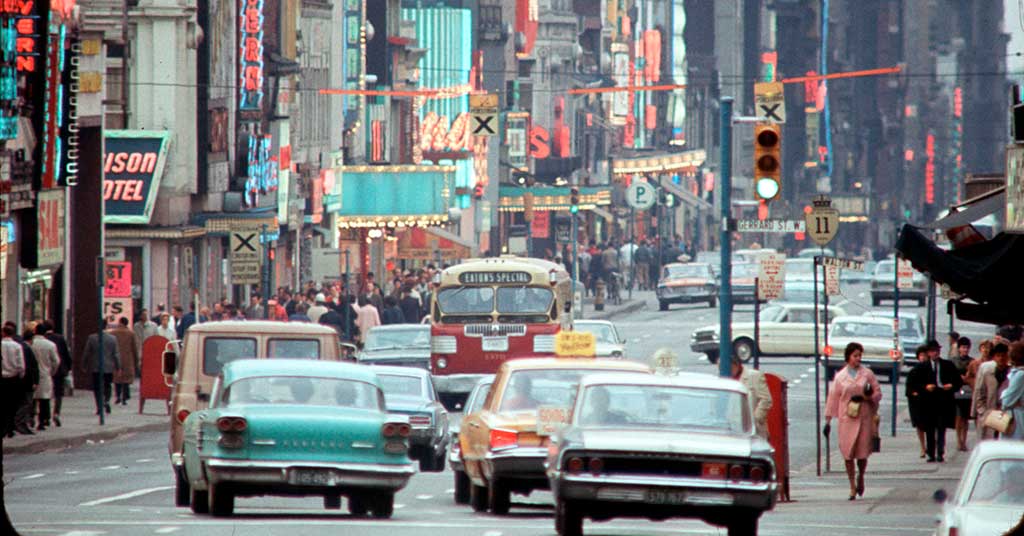
It wasn’t opulence, but there was discretionary income at the end of each week, particularly when the airfare debt was paid off. From the beginning, you had the distinct sense that you could start to get ahead and make a go of things. Mid-1960s Toronto had an optimistic buzz. In addition to feeling safe and non-threatening, it was a place where large projects still got executed expeditiously.
Because I came on my own without prior connections and tended toward introversion, I was often lonely. But people were invariably polite and sometimes actively kind. Nonetheless, as a newcomer who’d arrived of his own volition, it was assumed that I’d adapt to them rather than the other way around, which struck me as an eminently reasonable proposition.
One thing that did surprise me was how American Toronto was. Given its Anglo-Celtic background and heavy postwar European immigration, I’d expected something just a little different.
But virtually everything about the popular culture, the television shows people watched, the magazines they read, the sounds emanating from the radio, the culinary preferences, even the built environment, had a distinctly American flavour. That this co-existed with anxiety-tinged assertions of not being American didn’t alter the underlying reality.
On the economic front, the recently concluded Auto Pact had given a shove to the deep integration that was to follow over the ensuing decades. And the fact that the Kennedy administration had helped topple John Diefenbaker’s government just a couple of years previously didn’t seem to bother anyone. Youthful and glamorous, JFK was very popular in Canada, whereas Diefenbaker was a bombastic fuddy-duddy who’d already tarnished his original messianic promise (see March 2023 column on U.S. election interference and the fall of John Diefenbaker).
That, then, was my grateful immigrant experience 60 years ago. Not yet having started to thrash its history, Canada felt very good about itself. It was, as a popular centennial ditty put it, “a place to stand and a place to grow.”
Troy Media columnist Pat Murphy casts a history buff’s eye at the goings-on in our world. Never cynical – well, perhaps a little bit.
Explore more on Immigration, Canadian history
The views, opinions, and positions expressed by our columnists and contributors are solely their own and do not necessarily reflect those of our publication.
Troy Media empowers Canadian community news outlets by providing independent, insightful analysis and commentary. Our mission is to support local media in helping Canadians stay informed and engaged by delivering reliable content that strengthens community connections and deepens understanding across the country.

