
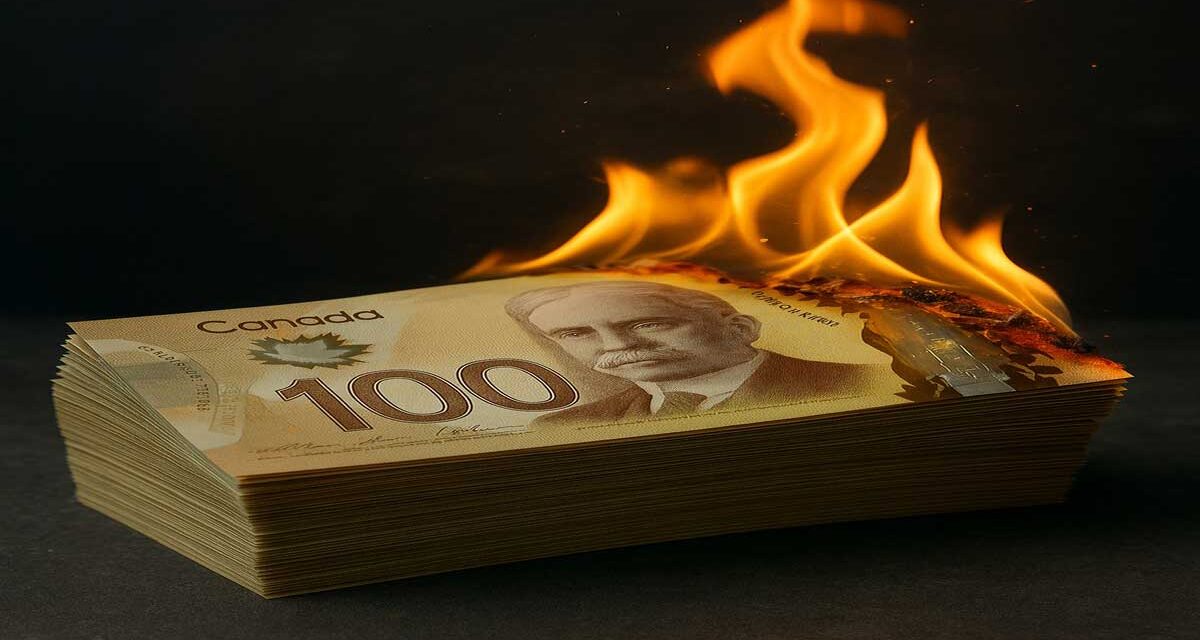
We’re not getting richer—we’re getting poorer. Canada needs to rethink how we use public dollars before the damage becomes irreversible

One of the sad truths about the real world is that there is no such thing as a free lunch—especially when it comes to building a prosperous economy. In Canada today, even basic resources like clean air, fresh water and financial capital are scarce. That’s why we must be far more deliberate about how we spend and invest—because poor choices are making us poorer.
As late as the last century, even dismal economists put forward the concept of a free good. Such a good was defined as being in sufficiently ample supply that everyone could use it for whatever purposes they wanted, in whatever quantities they wanted, and there would still be enough left over for all of us to continue to do the same.
Examples of such goods were rare. Two that were mentioned were air and water. It took people until fairly recently to sufficiently pollute the air to realize that if we continue to use the air freely to dump all our smoke and other airborne pollutants, there will not be enough clean, breathable air to support healthy life.
There is still plenty of water on Earth, but if we do not count the oceans and only consider clean, fresh, potable water, this is no longer a free good. Hikers in the wilderness now have to carry water purification tablets, as even remote streams are often not safe for drinking.
All goods are now scarce, which means we can’t afford to use them carelessly or thoughtlessly. We need to use our limited resources as wisely as possible.
One of the most important scarce resources in Canada is capital. We can think of it as the physical machinery, equipment and infrastructure that support our economy, or as the financial resources used to create those things. Capital isn’t valued for its own sake, but for its ability to generate the goods and services we rely on, and to raise our standard of living.
Average personal incomes in Canada have been falling. We are getting poorer. That makes it all the more important to invest our limited financial resources in productive capital that can help reverse that trend.
We call using dollars to produce capital “investment,” and investment is what remains from our incomes after consumer spending. Some of it is invested directly in businesses that create goods and services. Much of the rest goes to taxes.
Governments spend some of that tax money on pensions and benefits. Ideally, they would use most of the rest to fund public capital—the roads, pipelines, power generation and other infrastructure that make private investment more efficient. But that’s not what’s happening.
Since at least 1990, governments have been spending between 20 per cent and 25 per cent of our total gross national product—our overall economic output—on consumption, such as civil servant salaries, rather than on long-term investment. This ratio has been rising since 2020. At the same time, private sector investment has remained between 10 per cent and 13 per cent of economic output, trending closer to 10 per cent in recent years. This lack of investment—both public and private—is a major reason our standard of living is falling.
There are many reasons why private sector investment is weak, but they all boil down to a hard fact: financial capital is scarce. When governments use up a quarter of the country’s resources on programs and payrolls that don’t add to our capital base or productivity, there’s not much left to invest in real economic growth.
Governments frequently talk about shifting spending toward capital and away from consumption. But so far, it’s mostly talk. To make real progress, they should subject all spending to serious cost-benefit analysis—asking whether each dollar spent delivers measurable value to taxpayers and the economy.
What do we want from each government program or activity, and are we getting it? Are the generous salaries and benefits paid to civil servants really needed, especially when many of the taxpayers covering those costs are falling behind? And how long will it take before the many infrastructure projects now being promised by the federal government—such as transit expansions and clean energy investments—are actually built and contributing to Canada’s future?
There is no free lunch—or even any free goods—anymore. Everything, including vital capital, is scarce. If we want to raise living standards rather than watch them decline, we must ensure that our financial resources are directed to their most productive uses.
Dr. Roslyn Kunin is a respected Canadian economist known for her extensive work in economic forecasting, public policy, and labour market analysis. She has held various prominent roles, including serving as the regional director for the federal government’s Department of Employment and Immigration in British Columbia and Yukon and as an adjunct professor at the University of British Columbia. Dr. Kunin is also recognized for her contributions to economic development, particularly in Western Canada.
Explore more on Canadian economy, Federal politics, Federal taxes, Federal debt and deficit, Federal budget, Public sector, Economic policy
The views, opinions, and positions expressed by our columnists and contributors are solely their own and do not necessarily reflect those of our publication.
Troy Media empowers Canadian community news outlets by providing independent, insightful analysis and commentary. Our mission is to support local media in helping Canadians stay informed and engaged by delivering reliable content that strengthens community connections and deepens understanding across the country.

